- Home
- News and Resources
- Resources
- How Monthly Pharmacovigilance Data Reviews Support Clinical Trial Quality and Compliance
How Monthly Pharmacovigilance Data Reviews Support Clinical Trial Quality and Compliance
By Maleeha Hamdani
Key Takeaways
Monthly pharmacovigilance data reviews help clinical trial sponsors identify safety data issues earlier, improve data quality, support regulatory compliance activities, and reduce the burden of late-stage reconciliation. By reviewing adverse events, serious adverse events, medical history, concomitant medications, and other safety-related data throughout the study lifecycle, sponsors can address discrepancies before they affect timelines, submissions, or study closeout activities.
Why Are Pharmacovigilance Data Reviews Important?
Clinical trial sponsors rely on accurate safety data to protect patients, support regulatory submissions, and make informed development decisions. However, many safety data issues are not discovered until reconciliation activities or database lock preparation, when they are more difficult and time-consuming to resolve.
As clinical trials become increasingly global and data-intensive, maintaining visibility into safety data throughout the study lifecycle is becoming more important. Ongoing pharmacovigilance data reviews help sponsors identify potential issues earlier, improve data quality, and support more efficient study execution.
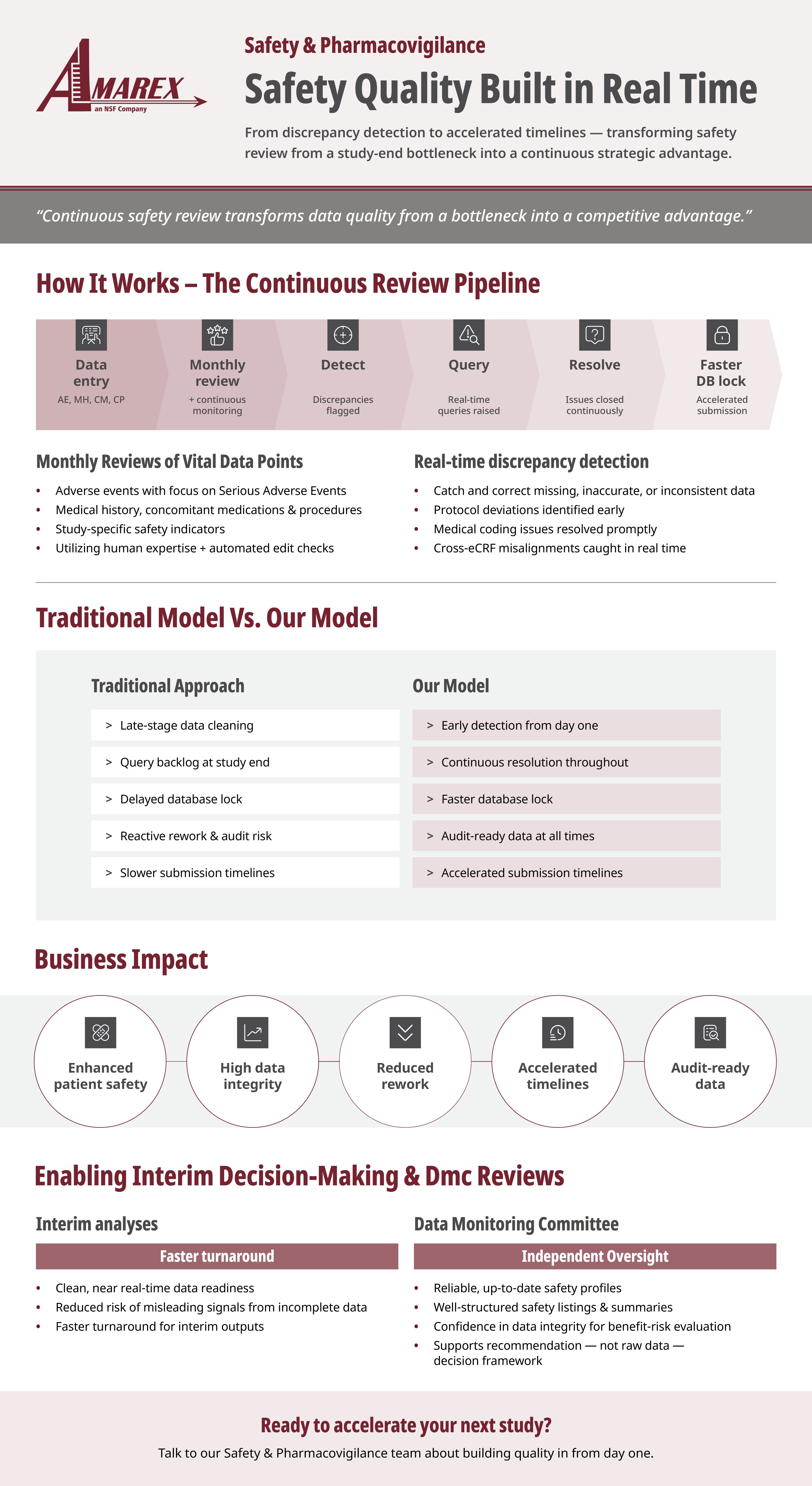
At Amarex, our Safety & Pharmacovigilance (SPV) team uses a proactive review model that embeds safety quality into routine trial operations from study startup through database lock. Rather than waiting until the end of a study to identify discrepancies, we conduct structured monthly reviews that help sponsors maintain oversight of critical safety data throughout the trial.
What Challenges Do Sponsors Face with Safety Data Management?
Many organizations still rely heavily on end-of-study reconciliation and final review activities to identify safety data issues. While this approach may uncover discrepancies before submission, it can also create significant operational challenges.
When issues are identified late in the study lifecycle, sponsors may face:
- Increased reconciliation workload
- Large volumes of outstanding queries
- Delays during database lock preparation
- Additional coordination among sponsors, CROs, sites, and data management teams
- Challenges with safety data traceability and documentation
Resolving these issues often requires significant time and resources at a critical stage of the study.
A proactive pharmacovigilance review process helps shift quality activities earlier in the lifecycle, allowing teams to address issues while information is still current and readily accessible.
What Does an Ongoing Pharmacovigilance Data Review Include?
Amarex’s monthly SPV data review service provides recurring oversight of key safety datasets throughout the study lifecycle. Reviews are designed to support the accuracy, completeness, consistency, and traceability of safety information.
Monthly reviews may include evaluation of:
- Adverse events (AEs)
- Serious adverse events (SAEs)
- Medical history (MH)
- Concomitant medications (CM)
- Clinical procedures (CP)
- Laboratory data
- Protocol-specific safety indicators
Reviews are performed by experienced pharmacovigilance and clinical safety professionals with expertise in regulatory requirements, medical coding standards, protocol compliance, and clinical trial operations.
The process is supported by programmed edit checks and data validation tools that help identify inconsistencies, missing information, and potential trends requiring further review. Combining clinical expertise with technology-enabled quality controls helps create a more efficient and consistent approach to safety oversight.
How Early Safety Data Review Helps Prevent Delays
One of the primary benefits of ongoing safety monitoring in clinical trials is the ability to identify and resolve issues before they accumulate.
Rather than waiting until study closeout, the SPV team works closely with sponsors and investigative sites throughout the trial, providing timely feedback and supporting issue resolution as data are collected.
Common findings identified during monthly reviews include:
- Missing, incomplete, or inconsistent safety data
- Delayed or missing SAE reporting
- Protocol deviations that may affect safety assessments
- Incomplete or inaccurate medical coding
- Misalignment across AE, MH, CM, and related eCRF fields
- Missing follow-up information for ongoing safety events
- Data entry errors affecting safety narratives or reporting timelines
- Incomplete documentation of actions taken or event outcomes
Identifying these issues earlier can help reduce the volume of work required during reconciliation and database lock activities. It can also improve collaboration among sponsors, CROs, and investigative sites by creating a consistent process for communication, review, and issue resolution.
How Pharmacovigilance Reviews Support Data Quality and Compliance
Regulators continue to emphasize patient safety, data integrity, and timely reporting throughout clinical development. Incomplete, inconsistent, or poorly documented safety data can create challenges during audits, inspections, data monitoring committee reviews, and regulatory submissions.
Ongoing pharmacovigilance reviews support safety data quality by helping sponsors:
- Improve consistency of safety documentation
- Identify reportable events that may require follow-up
- Strengthen traceability across safety datasets
- Improve visibility into potential data quality concerns
- Support preparation for downstream review and reconciliation activities
While no review process can guarantee regulatory outcomes, proactive oversight can help organizations strengthen their safety data management practices and address potential issues earlier in the study lifecycle.
Why Amarex Uses a Continuous Review Approach
Safety oversight is most effective when quality activities occur throughout a study rather than only at key milestones.
Amarex’s Safety Quality Built in Real Time approach integrates pharmacovigilance expertise, technology-enabled review processes, and ongoing collaboration with sponsors and sites. This continuous review model helps maintain visibility into safety data, supports informed decision-making, and promotes a culture of quality throughout the study lifecycle.
By embedding safety quality into day-to-day operations, sponsors can improve confidence in their safety data while supporting operational efficiency and patient safety objectives.
Frequently Asked Questions
What is a pharmacovigilance data review?
A pharmacovigilance data review is the ongoing evaluation of clinical trial safety data to identify inconsistencies, missing information, reporting delays, coding issues, and other findings that may affect patient safety, data quality, or regulatory reporting.
Why are monthly safety data reviews important?
Monthly reviews help identify issues while data are current and easier to resolve. Early detection can reduce reconciliation efforts, improve data quality, and support more efficient study execution.
What data are typically reviewed during pharmacovigilance reviews?
Reviews commonly include adverse events (AEs), serious adverse events (SAEs), medical history, concomitant medications, laboratory data, clinical procedures, and protocol-specific safety indicators.
How do pharmacovigilance reviews support regulatory compliance?
Ongoing reviews help organizations identify potential reporting gaps, improve documentation quality, strengthen traceability, and support timely follow-up of reportable events.
When should safety data reviews begin?
Safety reviews are most effective when initiated early in the study lifecycle and continued through database lock rather than being limited to end-of-study reconciliation activities.
Conclusion
High-quality safety data are essential to patient safety, regulatory decision-making, and successful clinical trial execution. As studies become more complex, organizations benefit from identifying and addressing safety data issues as early as possible.
Through structured monthly pharmacovigilance reviews, sponsors can improve visibility into critical safety data, support data quality initiatives, strengthen compliance activities, and reduce the burden of late-stage reconciliation. A proactive approach to safety oversight helps keep studies moving forward while supporting the quality standards expected throughout modern clinical development.